After a dry stretch, a wet September can make a struggling tree look like it should recover. Yet some trees continue losing foliage or developing dieback even after rainfall returns.
Rain can relieve moisture stress, but it cannot reverse every problem that developed during a dry period. Tree decline in Omaha may continue when root damage, poor drainage, compacted soil, pests, disease, or other underlying issues remain.
Rain Does Not Always Stop Tree Decline
A tree can remain affected by stress long after weather conditions improve.
During a prolonged dry period, fine roots can become damaged or less effective at absorbing water and nutrients. A tree may also reduce growth and conserve resources. When rainfall returns, these functions do not necessarily return to normal immediately.
This can create a delayed response. Continued thinning or dieback does not necessarily mean recent rainfall failed to reach the tree.
Rain also cannot correct conditions such as:
- Compacted soil around the root zone
- Poor drainage or prolonged saturation
- Root damage from construction or landscaping
- Physical damage to the trunk or branches
- Pest activity or disease
- Changes in grade or soil around an established tree
The key distinction is whether the tree is experiencing temporary moisture stress or a condition that rainfall cannot correct.
Signs of a Deeper Problem
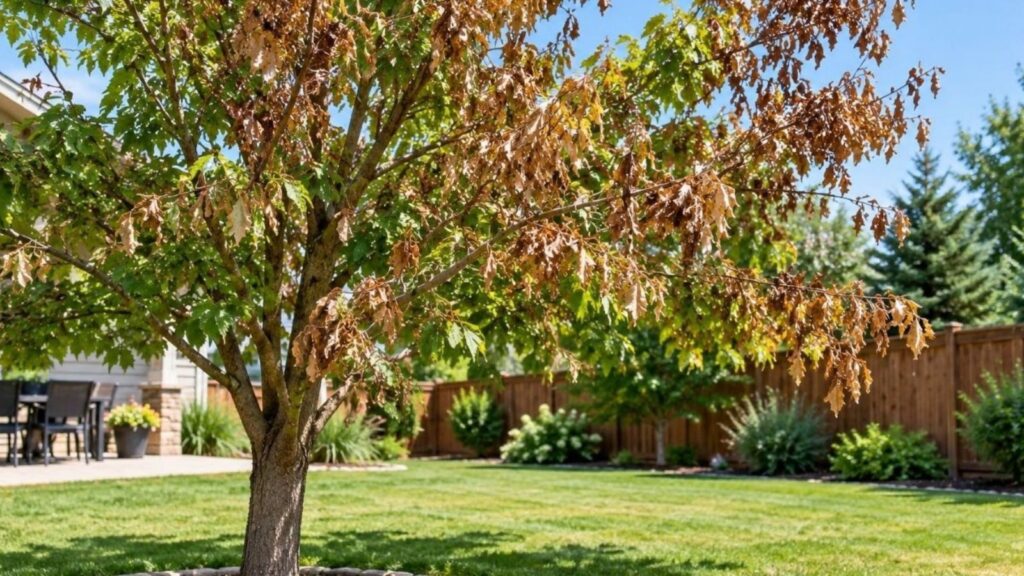
A common misconception is that every tree with thinning foliage after a dry period is simply experiencing a lack of water.
The pattern of decline provides useful context. During an assessment, tree care professionals look at where symptoms occur, whether they are spreading, and whether the canopy is declining evenly or in isolated areas.
Pay attention to:
- Sparse foliage across the canopy
- Individual branches dying
- Early leaf color changes
- Small or weak new growth
- Dead twigs in multiple areas
- Bark damage, cavities, or decay
- Standing water around the base
These signs do not identify a specific cause by themselves. They help establish a pattern that can be considered alongside the tree’s roots, trunk, branches, soil, and recent growing conditions.
Root-Zone Problems That Rain Cannot Fix
Leaves and branches may show visible signs of decline, but the underlying problem can begin in the root zone.
Several conditions can interfere with a tree’s ability to absorb water and nutrients, even when rainfall is plentiful.
- Compacted soil: Foot traffic, vehicles, and construction can restrict root growth and water movement.
- Poor drainage: Saturated soil can limit the oxygen roots need to function properly.
- Landscaping changes: Added soil or grading can alter conditions around established roots.
- Root disturbance: Construction or excavation can damage roots without causing immediate canopy symptoms.
- Standing water: Pooling after rain may point to drainage or grading problems.
A tree can receive plenty of rain and still struggle if its roots are damaged or water cannot move through the soil properly.
Warning Signs After a Wet September
Wet weather gives homeowners an opportunity to observe whether a tree is responding to improved moisture conditions.
Look for changes over time rather than expecting an immediate improvement. A tree that remains relatively stable presents a different picture from one that continues losing branches or developing new areas of dieback.
| What You Notice | What It May Indicate | What to Examine |
|---|---|---|
| Sparse foliage continues | Stress may extend beyond temporary dryness | Canopy and growing conditions |
| Water remains around the tree | Drainage may be a concern | Soil, grade, and runoff |
| One section declines | A localized problem may be present | Affected branches and roots |
| Dead twigs increase | Earlier stress may have continuing effects | Extent of dieback |
| Bark damage or decay appears | Structural or biological problems may be involved | Trunk and branches |
| New growth remains weak | Recovery may be limited by continuing stress | Overall tree condition |
The goal is not to diagnose the problem from one symptom. It is to determine whether the tree is improving, remaining stable, or continuing to deteriorate.
Steps to Take When Tree Decline Continues
If a tree continues to deteriorate after rainfall returns, avoid assuming that additional water is the solution.
Start by documenting the changes. Note when the decline began, which parts of the tree are affected, and whether symptoms are progressing. Photos taken from the same location over several weeks can help show gradual changes.
Then consider what happened around the tree before the decline appeared:
- Extended dry weather
- Construction or excavation
- Changes to nearby landscaping
- New soil or grading
- Flooding or standing water
- Pruning or branch damage
- Signs of insects or disease
Avoid making major treatment decisions based on one symptom. Adding irrigation, applying treatments, or removing branches without understanding the underlying issue may not address the reason the tree is declining.
When to Schedule a Professional Tree Assessment
Not every tree that looks stressed after summer requires immediate intervention. Some trees may gradually recover when the original stress was temporary and enough healthy roots and canopy remain.
However, a professional evaluation can be useful when:
- The canopy continues thinning
- Major branches are dying back
- The decline progresses despite improved moisture
- Standing water persists around the tree
- The trunk shows cavities, cracks, or other damage
- The tree has experienced significant root-zone disturbance
- The tree is near a home, driveway, street, or another area where falling branches or tree failure could create a safety concern
An assessment can help determine whether the concern involves the root zone, growing conditions, structural condition, pests, disease, or several factors together.
Several factors can contribute to tree decline in Omaha. Understanding what is affecting the tree can help determine whether monitoring, corrective care, pruning, or another management approach is appropriate.
Look Beyond the Rain
A wet September can improve growing conditions, but rainfall alone does not tell you whether a tree is recovering.
For declining trees in Omaha, pay attention to whether symptoms are stabilizing, where the decline is occurring, how the soil behaves, and what changed around the tree before symptoms appeared.
If the tree continues to decline, those observations provide a useful starting point for determining what needs closer attention. Addressing the underlying issue is more important than assuming additional rainfall will resolve the problem.
Frequently Asked Questions
How long should a tree take to recover after drought?
Recovery time varies depending on the tree species, severity and duration of stress, root condition, and growing environment. Some symptoms can persist after rainfall returns, and recovery may take more than one growing season. Watching whether the tree stabilizes or continues declining is often more useful than expecting recovery by a specific date.
Should I keep watering after a wet September?
Not necessarily. Check soil moisture and recent rainfall before adding irrigation. If the root zone is already saturated or drains poorly, additional water may make conditions worse.
What should I look for after heavy rainfall?
Watch whether water drains away normally, whether new symptoms appear, and whether existing dieback is progressing. These observations can help distinguish temporary moisture stress from a continuing problem.
Why is only one side of my tree declining?
Localized decline can have several possible causes, including damage affecting particular roots or branches, differences in exposure, or a localized structural, pest, or disease problem. The location of the symptoms can help guide a professional assessment.
Should I prune branches that died during the summer?
Dead branches may need to be removed, particularly when they create a safety concern. However, it is important to determine whether branches are actually dead and why they declined before undertaking extensive pruning. Large or hazardous branches should be evaluated and handled by qualified tree care professionals.
Tree Services of Omaha – Professional Tree Care
Tree Services of Omaha is a full-service tree care provider that offers a wide range of arborist services, including but not limited to: Tree Removal Services, Tree Trimming, Tree Pruning, Tree and Shrub Shaping, Stump Removal, Stump Grinding, Emerald Ash Borer Treatment, Mulch Delivery & Installation, Arborist Consultations, Systemic Tree Injection (Tree Healthcare).
Contact us today for a free estimate!