Every growing season, homeowners often judge a tree’s condition by what they can see in the canopy. Full, green leaves generally suggest that a tree is actively growing, but they don’t reveal everything happening inside the trunk, at major branch unions, or below the soil.
A tree can maintain a healthy-looking canopy while structural problems continue developing elsewhere.
Recognizing the difference between a tree’s biological health and its structural stability can help homeowners identify when an otherwise healthy-looking tree deserves a closer look.
A Green Canopy Shows Only Part of the Picture
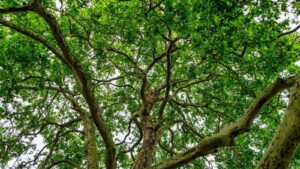
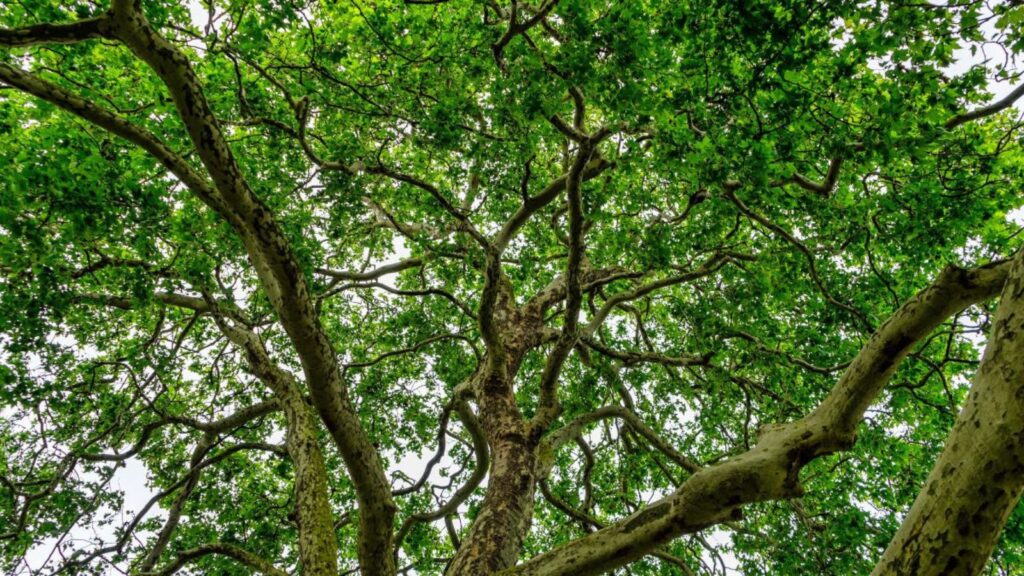
One common misconception is that a tree with full foliage is automatically safe to keep.
Leaf color and canopy density provide useful information about tree health, but they do not measure structural strength.
Several problems can develop without immediately affecting the leaves:
- Internal trunk decay
- Cracks in major stems
- Weak branch unions
- Root damage
- Included bark
- Previous storm injuries
A mature tree can continue producing leaves while structural defects develop in other parts of the tree.
That is why a professional tree assessment looks beyond the canopy when evaluating a tree’s overall condition and potential structural concerns.
Trunk Problems Can Develop Behind a Healthy Canopy
Homeowners often notice changes in the canopy before examining the trunk and major branches. However, visible changes to the trunk can provide an important reason for a closer evaluation even when the leaves still look healthy.
Several conditions deserve attention:
| What Homeowners Notice | What It May Indicate |
|---|---|
| Vertical trunk crack | Possible structural weakness |
| Cavity or hollow area | Internal decay or wood loss |
| Separating co-dominant stems | Potentially weak attachment |
| Large dead branch | Previous damage or localized decline |
| New trunk damage | Storm or mechanical injury |
| Mushrooms near the trunk base | Possible decay affecting the trunk or roots |
These signs do not automatically mean a tree needs to be removed. Their significance depends on their location, severity, progression, and relationship to the rest of the tree.
A homeowner may understandably dismiss a new trunk crack because the canopy still looks completely healthy. However, the absence of visible leaf decline does not eliminate a potential structural concern.
Root Problems May Not Immediately Appear in the Canopy
Roots provide another reason a green canopy should not be treated as proof of stability.
Construction, soil compaction, excavation, and drainage changes can damage roots or alter the conditions around them. Some problems may remain difficult to notice until the tree is subjected to high winds or saturated soil.
Warning signs around the root zone can include:
- Soil lifting near the trunk
- New cracks in the surrounding soil
- Exposed or damaged roots
- Recent excavation near the tree
- Significant changes in drainage
- A new or worsening lean
A tree may continue producing healthy leaves even after its root system has experienced significant disturbance.
This is particularly important when evaluating mature trees that have recently been exposed to construction, excavation, or major changes to the surrounding soil.
Storm Damage Can Reveal Hidden Weaknesses
Severe weather can expose structural problems that were difficult to notice beforehand. High winds place additional force on trunks and branch unions, while snow and ice can add significant weight to branches.
A healthy-looking canopy after a storm does not necessarily mean the tree escaped structural damage.
It is worth scheduling a professional assessment if:
- Major branches have broken.
- The trunk or a large limb has cracked.
- The tree has developed a new lean.
- Soil has shifted or lifted around the roots.
- Large branches are hanging or partially attached.
- The tree has struck a structure or another tree.
Some storm damage also becomes more apparent after the weather passes. Changes in trunk position, hanging branches, or movement around the root flare can indicate a problem that wasn’t obvious immediately after the storm.
If a damaged tree or branch poses an immediate danger to people, vehicles, or structures, keep the area clear and contact a professional tree removal company rather than attempting to remove large or unstable limbs yourself.
A Professional Tree Assessment Looks Beyond the Leaves
Many homeowners wait for yellowing leaves, thinning branches, or obvious decline before requesting an assessment. Structural problems do not always provide those warnings.
A professional assessment considers several parts of the tree together, including:
- Canopy condition
- Trunk and bark condition
- Major branch attachments
- Root flare and surrounding soil
- Signs of decay or damage
- Lean and overall tree structure
- Nearby buildings, vehicles, walkways, and other potential targets
The surrounding property matters because the same structural defect can present different levels of risk depending on what could be affected if part or all of the tree were to fail.
A green canopy is useful information, but it is only one part of evaluating a tree’s overall condition.
Why a Green Canopy Does Not Guarantee Tree Safety
A full canopy is generally a positive sign that a tree is actively supporting foliage, but it does not confirm that the trunk, major branches, or roots are structurally sound.
Cracks, cavities, leaning, root disturbance, and significant storm damage deserve attention even when the leaves remain green.
Homeowners don’t need to assume that every unusual feature means a tree should come down. In many cases, the appropriate next step is simply having the tree evaluated so the severity of the issue can be better understood.
Depending on the tree and the problem, professional recommendations may include monitoring, pruning, tree healthcare, or removal when a tree presents an unacceptable risk that cannot reasonably be managed.
Frequently Asked Questions
Can a healthy-looking tree have internal decay?
Yes. Internal decay can develop while a tree continues producing a healthy-looking canopy. Visible cavities, fungal growth, cracks, or changes around the trunk can warrant further evaluation.
Does a tree with green leaves need an inspection?
Not necessarily. However, healthy foliage should not be used to dismiss other warning signs such as significant cracks, leaning, root disturbance, or major storm damage.
Can root damage affect tree stability?
Yes. Damaged or compromised roots can affect a tree’s stability, particularly during severe weather. Recent excavation, construction, or major soil changes near a mature tree are worth mentioning during an assessment.
Do cavities always mean a tree is unsafe?
No. The location and extent of the cavity, the amount and condition of surrounding wood, and the tree’s overall structure all matter. A cavity should be evaluated in context rather than treated as an automatic reason for removal.
How soon should a storm-damaged tree be inspected?
Significant structural damage should be evaluated as soon as practical, particularly when large limbs have broken, the trunk has cracked, the tree has developed a new lean, or roots and surrounding soil have shifted.
Tree Services of Omaha – Tree Removal Services
Tree Services of Omaha, Nebraska is a full-service tree care provider that offers a wide range of arborist services, including but not limited to: Tree Removal Services, Tree Trimming, Tree Pruning, Tree and shrubs Shaping, Stump Removal, Stump Grinding, Emerald Ash Borer Treatment, Mulch Delivery & Installation, Arborist Consultations, Systemic Tree Injection (Tree Healthcare).
Contact us today for a free estimate!